Brain Science
Why your focus always keeps on dropping when it shouldn’t?
Your focus doesn’t suddenly disappear; it slowly breaks through constant mental restarts, unstable attention, and hidden cognitive fatigue that quietly disrupt your ability to sustain deep, consistent concentration.
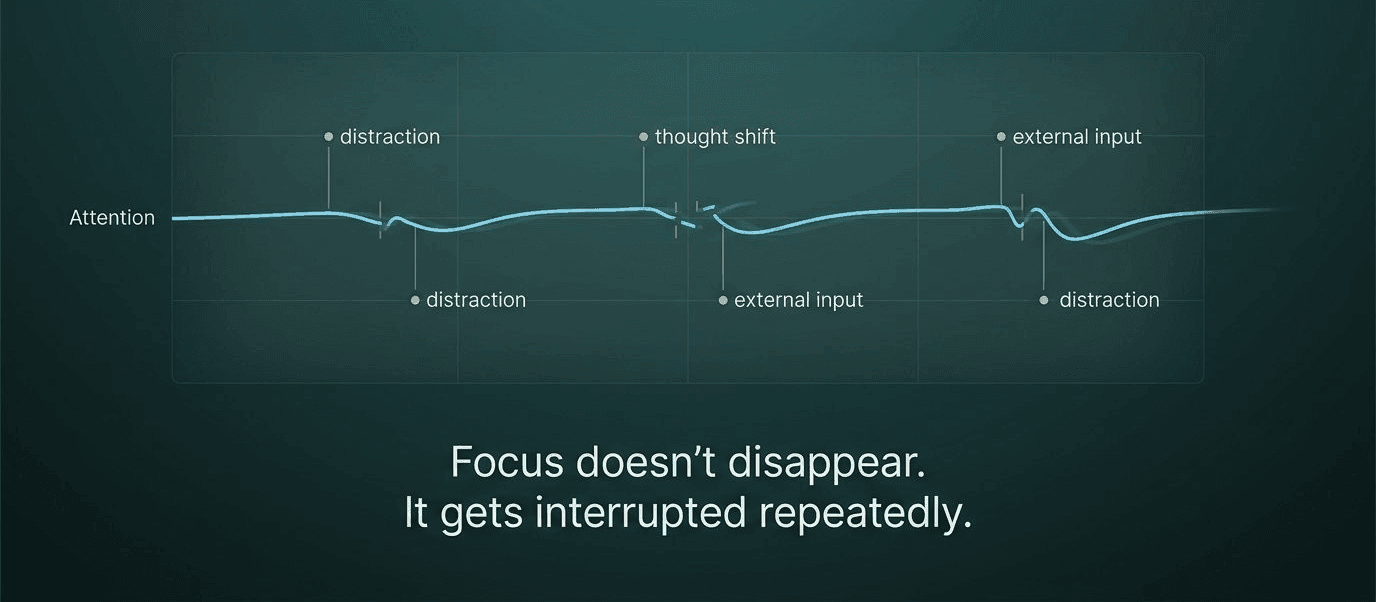
You’re trying to focus, but it doesn’t stay. You sit down to work with the intention to focus. For a few minutes, it works. You’re engaged, thinking clearly, moving forward with some level of control. Then something shifts. Your attention drifts. You reread the same line. You reach for your phone without even realizing when that decision was made. You try to bring your focus back. Sometimes it returns for a short while. Sometimes it doesn’t hold long enough to matter.
This cycle repeats often enough to feel frustrating and unpredictable. It’s easy to assume the problem is discipline or distraction. But in most cases, focus doesn’t drop because you’re not trying hard enough. It drops because your brain is not staying in a state that supports sustained attention.
Focus is not constant, it’s maintained!
Focus is not something you ‘switch on’ once and keep throughout a task. It’s something your brain must continuously maintain over time. That requires stability. When your brain is in a stable state, attention holds naturally. You don’t have to force it or constantly remind yourself to stay engaged. But when that stability starts to fluctuate, focus becomes harder to sustain, even if your intention remains strong.
This is where the problem begins. Your brain keeps shifting slightly:
- attention breaks for a moment
- it takes effort to return
- that effort increases over time
These small disruptions don’t feel significant individually. But together, they create a pattern where focus keeps dropping instead of staying steady.
Why your brain keeps interrupting itself
One of the biggest reasons focus drops is internal instability. Your brain is constantly balancing between engagement and distraction. When that balance isn’t stable, it keeps shifting even without obvious external triggers or interruptions. This can happen when:
- your mental energy is uneven throughout the task
- your attention hasn’t settled into a consistent rhythm
- your brain is slightly overstimulated without you realizing it
The hidden cost of re-focusing
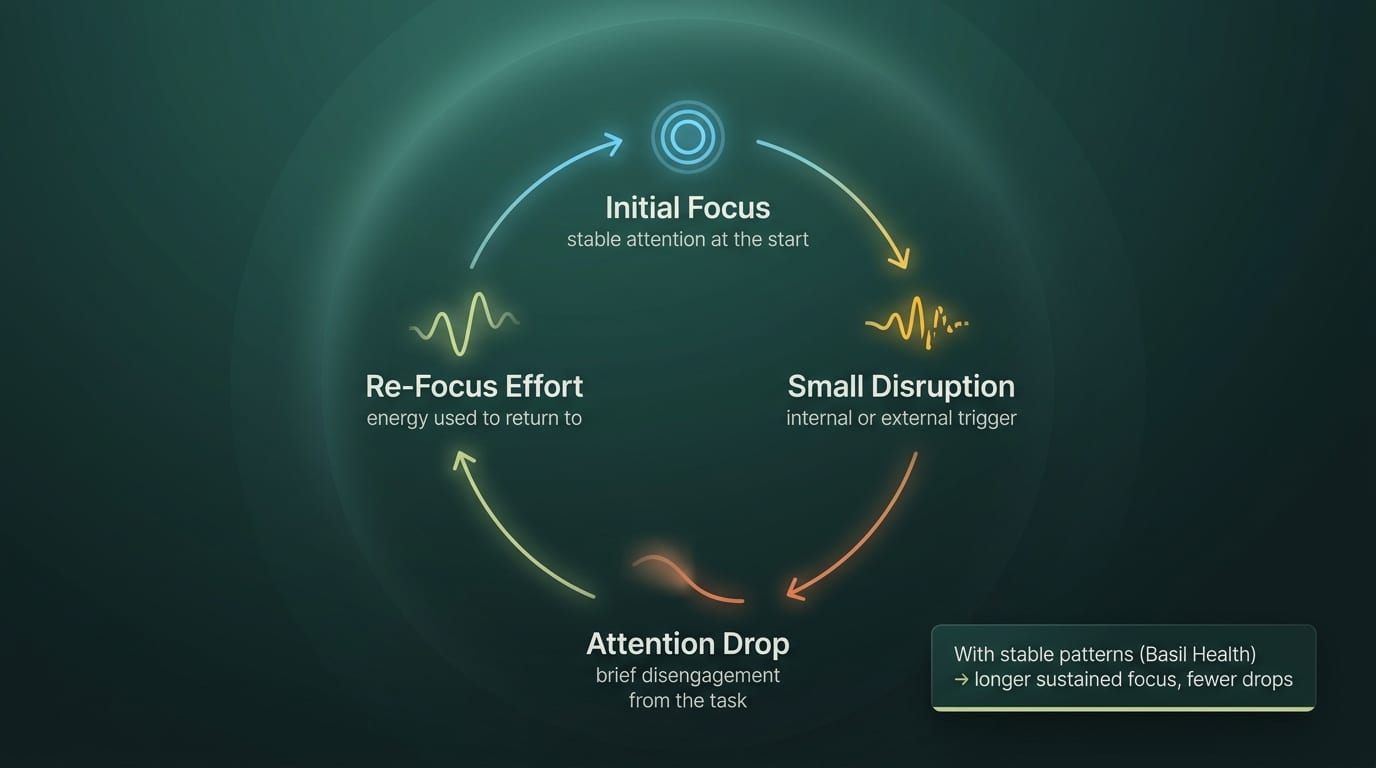
Every time your focus drops, you don’t just lose a moment. You must restart. That restart requires effort, for example you reorient yourself to the task, you rebuild context and understanding, you regain momentum that was lost, etc. This process is subtle, but it consumes more energy than you realize. When it happens repeatedly, your brain spends more time recovering focus than sustaining it. This is why even short periods of unstable attention can feel exhausting and unproductive by the end of the day. Not because you weren’t working, but because your focus wasn’t continuous enough to build momentum.
How focus keeps breaking throughout the day
At some point, the pattern becomes clearer when you step back.
Why forcing focus doesn’t always work
When focus keeps dropping, the natural instinct is to try harder and push through. But effort alone doesn’t fix instability. If your brain is not in a state that supports sustained attention, pushing harder often leads to faster mental fatigue, more frequent attention breaks, and reduced clarity over time. The issue is not willingness, it’s the state.
When Basil Health brings visibility to these patterns, you start seeing when your focus is stable and when it’s fluctuating. That changes how you approach work—not by forcing attention, but by understanding when it can be sustained effectively.The takeaway
Focus doesn’t disappear randomly or without reason. It drops because it’s not being maintained consistently over time. Small interruptions. Repeated restarts. Unstable mental states. These create a pattern where attention keeps breaking instead of holding long enough to build momentum. The challenge is that you only notice the drop, not the pattern behind it. And once you understand that pattern clearly, the problem becomes easier to approach in a more effective and structured way.
Frequently Asked Questions
1. Why does my focus keep dropping even when I try?
Because focus depends on stability. If your brain state keeps fluctuating, attention becomes harder to sustain consistently.
2. Is distraction always caused by external factors?
No. Internal instability, like shifting attention or uneven mental energy, can cause focus to drop even without obvious distractions.